Love this? Save it for later!
Share the inspiration with your friends
Introduction
“You know that moment when you stand in front of the cutting board, staring at a shiny onion, and suddenly your eyes are watering like crazy?” That was me last Tuesday evening, right after work, trying to prep dinner in a hurry. Honestly, I wasn’t expecting much drama from such a simple vegetable, but chopping an onion had always felt like a secret art I hadn’t quite cracked. I remember grabbing the knife, fumbling with the slippery onion skin, and—surprise!—tears streaming down my face before I’d even made the first slice.
It wasn’t until my neighbor, Mrs. Patel, peeked over the fence and chuckled at my predicament that she shared her no-fail method for chopping onions. She claimed it was foolproof, beginner-friendly, and would keep the tears at bay. Naturally, I was skeptical—maybe you’ve been there, too, thinking chopping onions is just about brute force and speed. But after a few tries following her advice, I realized it wasn’t just about the knife skills, but the approach and small tricks along the way.
So, whether you’re a kitchen newbie or someone who just wants to stop crying every time you prep dinner, this easy step-by-step guide on how to chop an onion is for you. I’ve packed it with tips I learned the hard way (including that one time I almost chopped my finger—don’t worry, I’ll keep you safe!). Let me tell you, mastering this simple skill makes cooking so much less intimidating and way more fun. Let’s get chopping!
Why You’ll Love This Recipe
After spending countless evenings battling tears and awkwardly chopping onions, I finally nailed a method that feels effortless and safe. Here’s why this easy how to chop an onion guide stands out:
- Quick & Easy: Comes together in under 10 minutes, perfect for busy beginners or last-minute meal prep.
- Simple Ingredients: No special tools or fancy gadgets needed—just an onion, a sharp knife, and a cutting board.
- Perfect for Any Meal: Whether you’re making a hearty stew, a fresh salsa, or just need diced onions for crispy garlic chicken, this technique works every time.
- Crowd-Pleaser: Even picky eaters appreciate the clean, uniform onion pieces that cook evenly and add balanced flavor.
- Unbelievably Practical: Once you get the hang of it, chopping onions feels like second nature—and you’ll save so much prep time.
This isn’t just another chopping tutorial. The method I’m sharing respects the onion’s layers, controls how the juices release (goodbye, tears!), and gives you consistent results you can rely on. Honestly, it’s the kind of basic skill that opens up so many cooking possibilities and builds your kitchen confidence. Whether you’re a total beginner or just want to sharpen your skills, you’ll find this guide easy to follow and surprisingly satisfying.
What Ingredients You Will Need
This guide focuses on the humble onion, but knowing a bit about picking the right one can make a big difference in your chopping experience.
- Yellow onion: The most common and versatile onion, perfect for sautéing and cooking. Look for firm bulbs with dry, papery skin that’s free of soft spots.
- White onion: Sharper and crisper than yellow onions, great for salads or salsas. Use the same chopping technique regardless.
- Red onion: Milder and often eaten raw, especially in sandwiches or salads. Make sure the onion is fresh and firm to avoid mushy pieces.
For your chopping toolkit, you’ll need:
- Sharp chef’s knife: A 6 to 8-inch blade works best. I personally recommend brands like Wüsthof or Victorinox for reliable sharpness and balance.
- Cutting board: A sturdy, non-slip board—wood or plastic both work. I like using a slightly damp towel underneath to keep it steady.
- Optional: A small paring knife for trimming the root and tip, if you prefer.
Substitution tips: If you’re allergic to onions or prefer less pungent options, you can chop shallots, leeks, or green onions using a similar technique. Just keep in mind their different sizes and textures when adjusting chopping styles.
Equipment Needed
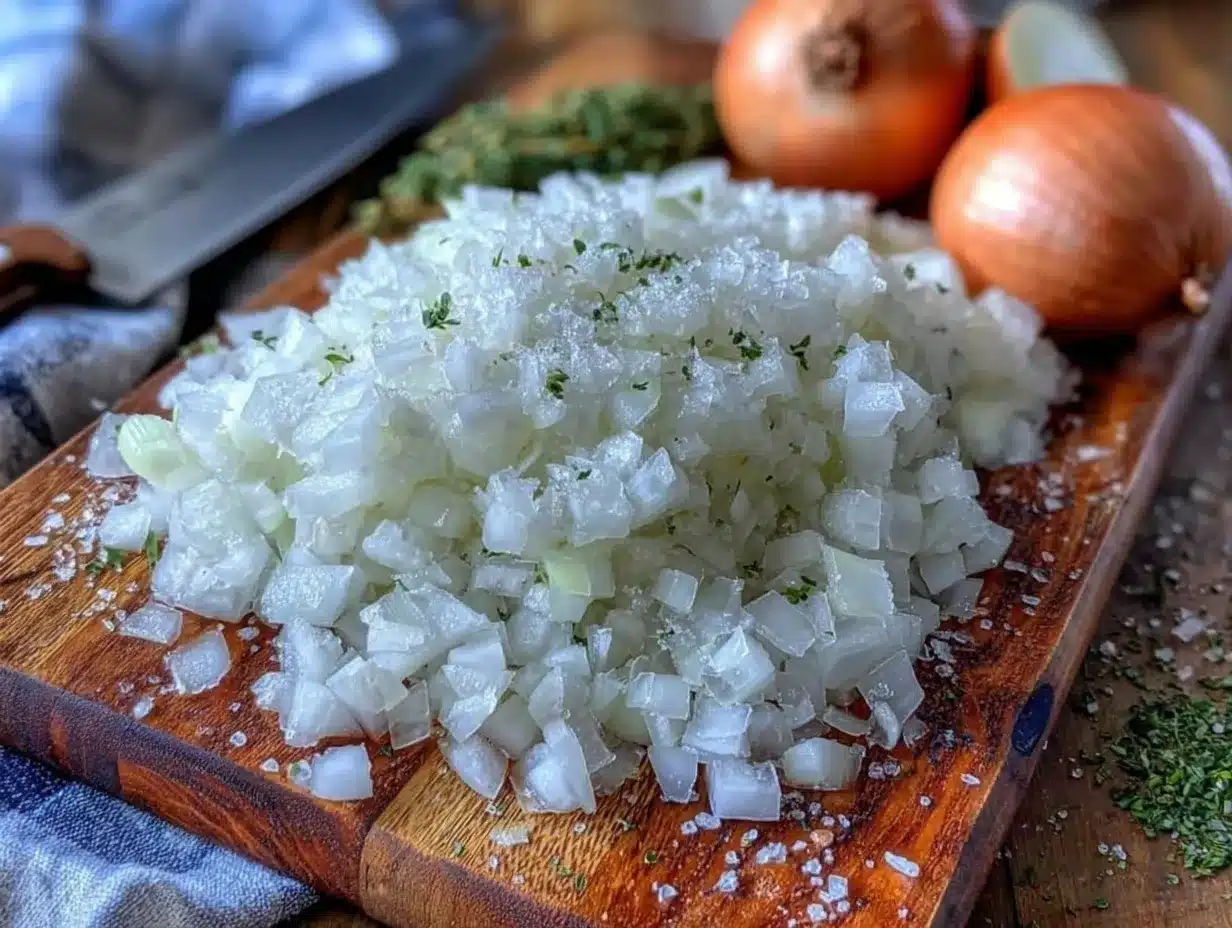
- Chef’s knife: The star of the show. A sharp, comfortable chef’s knife is essential. If you’re on a budget, brands like Mercer Culinary offer great quality for less.
- Cutting board: Choose one large enough to give you room to work safely. Bamboo or plastic boards are easy to clean and maintain.
- Optional kitchen towel: To stabilize your cutting board or wipe your knife if the onion juices make it slippery.
- Knife sharpener: Keeping your blade sharp is key. A simple honing rod or pull-through sharpener will do wonders.
Personally, I’ve tried chopping onions with serrated knives and paring knives, but nothing beats a sharp chef’s knife for clean, efficient cuts. I once tried a cheap plastic cutting board that slipped all over the place—lesson learned to keep a damp towel underneath for safety. If you don’t have a sharpener, many grocery stores or kitchen shops offer affordable sharpening services, which can save you frustration and accidents.
Preparation Method
- Trim the onion: Start by cutting off the top (stem end) of the onion with your chef’s knife—about ½ inch (1.3 cm) from the tip. Leave the root end intact to hold the layers together while chopping.
- Peel off the skin: Slice the onion in half from top to root. Remove the papery outer skin and any slimy or dry layers beneath. If the skin is stubborn, gently rub it with your fingers or use the knife tip to loosen it.
- Place the onion flat side down: Lay one half of the onion flat on the cutting board with the root end facing away from you. This gives you stability and control.
- Make vertical cuts: Holding the onion steady with your non-dominant hand, make vertical cuts from the top toward the root, about ¼ inch (0.6 cm) apart. Be careful not to slice through the root—keep it intact to hold the onion together.
- Make horizontal cuts: Next, slice horizontally through the onion, parallel to the cutting board, about ¼ inch (0.6 cm) apart. Depending on the onion size, you might make one or two horizontal cuts. Watch your fingers!
- Dice the onion: Finally, cut across the onion, perpendicular to your vertical cuts, moving from the top toward the root. The onion will fall away into neat, uniform pieces.
- Repeat with the other half: Follow the same steps for the remaining onion half.
- Clean up: Use the tip of your knife or your fingers to gather any stray pieces for easy transfer to your dish or pan.
Preparation notes: If your eyes start to water, try chilling the onions in the fridge for 10-15 minutes before chopping or cutting near an open window. Also, keep your knife sharp to make clean cuts—dull blades crush the onion’s cells and release more irritants.
When you’re done, admire those perfectly diced onions! The pieces should be roughly the same size, which helps them cook evenly. I remember one time I got distracted by a phone call mid-chop and ended up with some big chunky bits and tiny slivers—lesson learned to focus fully on your chopping!
Cooking Tips & Techniques
Chopping onions might seem straightforward, but a few tricks can make it easier and safer:
- Keep your fingers tucked: Use the “claw grip” with your non-cutting hand, curling fingertips inward to avoid accidental nicks.
- Sharp knife is a must: A dull blade is more dangerous because it slips. Regularly hone or sharpen your knife to keep chopping smooth.
- Control the onion juices: Cutting near the root last helps minimize the release of sulfur compounds that cause tears.
- Chill onions before chopping: Cold onions release fewer irritants. If you’re sensitive, pop them in the fridge for 15 minutes before you start.
- Work on a stable surface: A damp kitchen towel under your cutting board prevents slipping and accidents.
- Take your time: Rushing leads to uneven cuts and injuries. Slow and steady wins the onion-chopping race.
One time, while rushing dinner prep, I chopped the onion too quickly and ended up with a patchy dice—some pieces cooked faster, others barely softened. Since then, I pay attention to uniformity, which really improves the final dish texture and flavor. Honestly, mastering these small techniques turns a dreaded task into a quick, even enjoyable part of cooking.
Variations & Adaptations
Not all onions are created equal, and chopping techniques can be tweaked to suit your needs or preferences:
- For sweeter onions like Vidalia: Use the same method but you might find the layers softer and easier to separate, so handle gently to avoid mushy pieces.
- For green onions or scallions: Slice thinly across the stalk without worrying about the root—great for garnishes or quick sautés.
- For larger onions: Consider making more vertical and horizontal cuts for smaller dice, especially if you want the onion to blend well into sauces.
- Allergen-friendly substitution: If you’re sensitive to onions, try chopping fennel bulb for a similar crunch and mild flavor in salads or sautés.
- Different cooking methods: If you’re caramelizing onions, chunkier pieces work better to prevent burning, so adjust your dice size accordingly.
I once swapped yellow onions for shallots in this chopping method when making a delicate vinaigrette, and it worked beautifully. The key is to adjust the size and technique based on onion type and recipe needs, so feel free to experiment once you’ve mastered the basics.
Serving & Storage Suggestions
Diced onions are incredibly versatile and can be served raw or cooked. Here’s how to get the most out of your chopped onions:
- Serving temperature: Use chopped onions raw in salads, salsas, or sandwiches for a sharp kick, or cook them down for soups, stews, and sautés to mellow their flavor.
- Complementary dishes: Onions pair beautifully with garlic, tomatoes, bell peppers, and herbs like thyme or cilantro. Try them in dishes like classic beef stew or fresh guacamole for depth and aroma.
- Storage: Store chopped onions in an airtight container in the refrigerator for up to 7 days. For longer storage, freeze them on a baking sheet then transfer to a freezer-safe bag for up to 3 months.
- Reheating tips: Use frozen chopped onions directly in cooked recipes without thawing to avoid sogginess.
- Flavor development: Raw onions mellow as they sit; if you have time, let chopped onions rest in the fridge for an hour to soften their bite before using them raw.
Nutritional Information & Benefits
Onions are low in calories but pack a nutritional punch. A 100-gram serving (about one medium onion) provides roughly 40 calories, 1.1 grams of fiber, and a good dose of vitamin C, vitamin B6, and manganese.
The sulfur compounds responsible for onion’s tear-inducing power also offer antioxidant and anti-inflammatory benefits. Some studies suggest onions can support heart health and help regulate blood sugar. Whether raw or cooked, onions add flavor and nutrition with very few calories.
If you have sensitivities or allergies, be mindful that onions are part of the FODMAP group and may cause digestive discomfort for some. But for most, they’re a delicious and healthful staple.
Conclusion
Learning how to chop an onion might seem like a small thing, but it truly opens up your cooking potential and saves you from tears and frustration. This easy step-by-step guide is designed to make the process approachable and even a little fun. Remember, the key is a sharp knife, steady hands, and a bit of patience.
I love this method because it’s straightforward and adaptable to any onion type or recipe. Plus, it’s helped me feel more confident in the kitchen overall—there’s something satisfying about turning a whole onion into perfectly diced pieces ready to flavor any meal.
Give it a try and let me know how it goes! If you have your own tips or twists on chopping onions, I’d love to hear about your experience in the comments. Happy chopping!
FAQs About How to Chop an Onion
What’s the safest way to hold an onion while chopping?
Use the “claw grip” by curling your fingertips inward and holding the onion steady with your knuckles forward. This protects your fingers from the knife blade.
How do I stop my eyes from watering when chopping onions?
Try chilling the onion beforehand, cutting near a fan or open window, or using a sharp knife to reduce cell damage that releases irritants.
Can I use any knife to chop onions?
A sharp chef’s knife is best for clean, efficient cuts. Avoid dull or serrated knives, which can crush the onion and cause uneven pieces.
How do I store chopped onions to keep them fresh?
Place chopped onions in an airtight container or resealable bag and refrigerate for up to a week. For longer storage, freeze them on a tray before transferring to a freezer bag.
Is there a way to chop onions faster without sacrificing safety?
With practice, your speed will improve. Focus on proper knife skills and keeping the root intact to hold the onion together. Don’t rush—accuracy beats speed when it comes to safety.
Pin This Recipe!
Easy How to Chop an Onion for Beginners Step-by-Step Guide with Tips

A beginner-friendly, step-by-step guide to chopping onions safely and efficiently, minimizing tears and ensuring uniform pieces for any meal.
- Prep Time: 5 minutes
- Cook Time: 0 minutes
- Total Time: 5 minutes
- Yield: Varies (depends on onion size, typically 1 medium onion yields about 1 to 1.5 cups diced)
- Category: Preparation Technique
- Cuisine: Universal
Ingredients
- Yellow onion
- White onion
- Red onion
Instructions
- Trim the onion: Cut off the top (stem end) about ½ inch from the tip, leaving the root end intact.
- Peel off the skin: Slice the onion in half from top to root and remove the papery outer skin and any slimy or dry layers beneath.
- Place the onion flat side down on the cutting board with the root end facing away from you.
- Make vertical cuts about ¼ inch apart from top toward the root, keeping the root intact.
- Make horizontal cuts about ¼ inch apart, parallel to the cutting board, one or two depending on onion size.
- Dice the onion by cutting perpendicular to the vertical cuts, from top toward the root.
- Repeat the steps with the other half of the onion.
- Clean up by gathering any stray pieces with the knife tip or fingers.
Notes
Keep the root end intact to hold onion layers together while chopping. Use a sharp knife to reduce cell damage and tears. Chill onions for 10-15 minutes before chopping to minimize eye irritation. Use a damp towel under the cutting board to prevent slipping. Use the claw grip to protect fingers.
Nutrition
- Serving Size: About 1 medium onion
- Calories: 40
- Sugar: 4.7
- Sodium: 4
- Fat: 0.1
- Carbohydrates: 9
- Fiber: 1.1
- Protein: 1.1
Keywords: chop onion, how to chop onion, onion chopping guide, beginner onion chopping, onion prep, kitchen skills